 La Boqueria is one of the places you absolutely must visit in Barcelona. The origins of the market itself are very old, and it is difficult to pinpoint the exact date, also because some activities, such as the sale of meat and fish, took place as early as 1200 in the lougo where the market now stands. The structure of the Boqueria as we see it today, however, is rather modern. This was inaugurated in 1840, following the fire that destroyed the monastery that stood there. If you're looking to stay close to La Boqueria market, Ofelias Hotel is a great option. Located just a 10-minute walk away, the hotel offers comfortable accommodations with easy access to the market's fresh produce and lively atmosphere. With its central location, you can also explore other popular attractions nearby such as the Gothic Quarter and La Rambla. Make the most of your trip to Barcelona and stay at Ofelias Hotel for a truly memorable experience.
Opening hours and prices
-
Hours: Monday to Saturday from 8 a.m. to 8.30 p.m.
-
Best time for crowds: the attraction in question is a market, so crowds of people are part of its appeal. If you want to visit at a time 'with few people', the time slot from 9 to 11 am and from 7 pm until closing time is recommended.
-
Cost of visit: admission is free
Tours, guided tours and online tickets
What to see and how to visit the Boqueria Market
 St. Joseph's Market, or 'La Boqueria', is a perfect place to buy fresh produce, although it has now almost lost its role as a market to become a full-time tourist attraction. The colourful and lively market is a 2,500 square metre labyrinth, occupied by more than 300 stalls, where you can buy any product.
The market is named after the convent of Sant Josep, which stood on the same site before it was destroyed by fire. A Catalan architect, Josep Mas i Villa, transformed the area into a market where, initially, the stalls met out in the open, but then, for obvious reasons, it was covered by the current structure built in 1914.
The main entrance, built of wrought iron, decorated in a modern style and adorned with stained glass panels, features the celebrated sign at the top with the market's name on it. The real attraction of the Boquerie are the vendors' stalls. The products are displayed in such a meticulous and careful manner that even the colour nuances are respected. Among the most characteristic stalls are those selling fruit and vegetables, especially exotic ones, and the famous 'gastronomic bookshop'.
Where is it located and how to get there
-
On foot: the market is located halfway down La Rambla. Get directions
-
By bus: Lines 59, V13
-
By metro: Liceu stop, on green line L3
Useful tips for visiting the attraction
-
Get up early: ideally you should reach the entrance before opening hours.
-
Be careful: pickpockets proliferate in the market
-
Minimum time: it is advisable to take as much time as possible to sample at least two of the characteristic take-away dishes designed especially for tourists.
-
Eating at the Boqueria: the stands at the Boqueria are full of typical products, an absolute must is Jamon, the local ham, also available in skewer form, which costs no more than a reasonable €5.00. A point of reference among the local restaurateurs is Clemen's Boqueria, the bar/restaurant occupying number 111, specialising mainly in fish dishes. Although there is a large crowd, resulting in a long wait for seats, the service is fast and the prices are close to the Italian average: pulpo gallega, salmon, fried squid and seafood salad total €41.00. One of the highlights of the Boqueria is the sale of exotic fruit, also available in smoothie or fruit salad format, with prices ranging from €1.50 to €2.00. Fruit specialities, such as Jamon, can also be found on almost every stand in the market, but not to be missed are those of the Fruites y Verdures Soley Roser stall at number 508.
History, trivia and practical info: what to know in brief
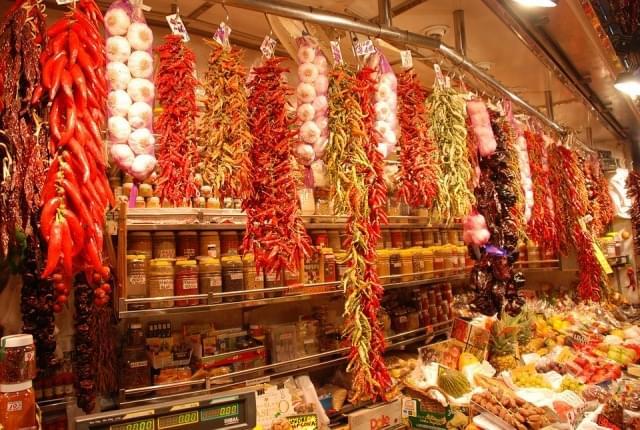 Born at the beginning of the 17th century in the Plade de Boqueria, on the outskirts of the city, it was later inaugurated in 1836 in its current location, between the Virreina Palace and the Liceu Theatre. The market took the place of the convent of San Josep, from which it derives its name, and which was destroyed by fire. The name 'Boqueria' seems to have come from the sale of carne de Boc, the Catalan word used to indicate the male goats that, in the 13th century, used to graze in the same area where the market now stands.
Today, La Boqueria is not only a market where one can find products that would otherwise be difficult to find, but also a tourist attraction that attracts visitors from all over the world, and above all, one of the most important markets in the world. La Boqueria is twinned with London's BoroughMarket, and there are frequent collaborations between the two, such as the presence of the Catalan market in London in 2008 on the occasion of the reopening of the London market.
Related articles

11 Best Barcelona Hotels near Casa Calvet, Spain in 2021 - barcelonahotels.info

11 Best Barcelona Hotels near Palau de la Musica Catalana, Spain in 2024 - barcelonahotels.info

Hotel Banys Orientals Barcelona: 3 star Hotel with a Minimum Price 173.897€| UPDATED FOR 2024 | barcelonahotels.info

Where to sleep in Barcelona Opinions and advice by neighbourhood

6 Best 3 Star Hotels in Barcelona, Spain in 2024 - barcelonahotels.info

Hostal Sans Barcelona: 2 star Hotel with a Minimum Price 73.0738€| UPDATED FOR 2024 | barcelonahotels.info